Have you ever thought, “I’m not all set for that promo” or “I’ll never ever truly master public talking”?
Such negative thoughts prevail and frequently identified as limiting ideas
Sometimes, individuals believe things about themselves that aren’t true. These thoughts can hide in their minds. They do not also understand they’re there. However the thoughts can still quit them from succeeding at the office. This can occur even if the person is very good at their job.
Picture an actually great chef. They can cook extremely well, but they think they can’t be the one in charge in the kitchen area. They assume they weren’t born to be a leader. As a result of this, they don’t attempt to come to be the head cook.
The impact is a straight cap on their capacity, which affects both the firm and overall staff member well-being
The overview shares valuable pointers, shows how to find these usual ideas in your group, and offers very easy ways to help people alter these ideas. This helps support their individual growth and joy along with their specialist growth.
What are self-limiting ideas?

Self-limiting ideas are thoughts we inform ourselves. These ideas claim what we can or can’t do. They are ideas we believe regarding ourselves and the globe.
These ideas are not truths. They are solid thoughts our company believe. We often don’t understand where they originate from, and can start from points that happened before. They can come from what others claim or what we see in the world around us.
Some people have solid psychological intelligence , which allows them to sidestep a lot of these ideas, yet some get entirely taken in by them.
These ideas resemble unseen fencings. They assist what we do and stop us from attempting new things. We don’t always see them. For example, a wonderful sous-chef might assume, ‘I’m efficient making new meals. Yet I’m not good with budgeting or leading individuals. So I can’t be a head cook.’
While this sentence might really feel really genuine to the individual, it’s an idea, not a taken care of characteristic.
Due to that idea, the cook may not pursue a larger job. They miss out on a possibility to grow as a leader or utilize their cooking skills more.
How restricting beliefs impact success in the office
Self-limiting beliefs act as effective , unseen brakes on success
When these ideas get more powerful, individuals start claiming no to large opportunities. They could not pursue a promotion. They could skip leading an exciting task; they quit themselves without even knowing it.
The individual might feel they’re merely not ‘suitable it,’ despite their real abilities. People could make huge task choices for the wrong reason. They feel like they’re unsatisfactory and don’t count on themselves. So they pick based on worry, not self-confidence.
Our skilled chef could think, ‘I’m efficient cooking, however not at leading or taking care of cash.’ As a result of this thought, they may miss out on opportunities to grow. They could not organize inventory or share a big idea for a brand-new restaurant. They keep back rather than tipping up.
For that reason, their possibilities of obtaining executive roles are lower, not since they do not have sufficient cooking abilities, but due to the fact that they lack the required managerial skills.
When people prevent trying new points, they stay in their convenience area, eventually restricting their development. Carol Dweck , an attitude specialist, claims some individuals think their skills can not change. They feel they need to keep proving they’re excellent rather than discovering new points.

4 restricting ideas instances we commonly face
Self-limiting ideas subtly yet constantly shape our specialist lives. Frequently appearing as sensible thoughts, they can be complicated to area. Understanding common patterns assists in recognizing them within ourselves and our teams.
Allow’s walk through the four most common examples , as translucented our cook.
The “Not Really Adequate” belief
Connected to impostor syndrome , whispers that success are luck, not ability, impart fear of exposure. Our cook, who was applauded for a brand-new menu, may assume, “A fluke– wonderful ingredients. Can’t duplicate it. They’ll see I’m not that cutting-edge.” This question results in downplaying success and avoiding high-stakes tasks.
The “I Absence the Crucial High qualities” idea
Shows a dealt with state of mind It’s the sentence that essential skills are unchangeable, and one lacks what’s needed for sure duties. Faced with a vital GM training chance needing economic acumen, our chef muses, “I’m a cook, not a numbers individual. You either have that organization feeling, or you do not.” As a result, they may avoid programs important to wider leadership.
The “It’s As well Risky, I’ll Fail” belief
This one is rooted in fear of failure Worry concerning excruciating effects can disable campaign. When prompted to make an experimental menu, our chef believes, “If it flops, my track record suffers. It’s safer to be traditional.” This results in conservative selections, suppressing imaginative growth.
The “Success Isn’t for A Person Like Me” idea
It originates from unworthiness or self-limitations — a feeling that large accomplishments are for others. Observing peers from elite institutions in top duties, our chef from a neighborhood program mirrors, “Those duties most likely to cooks with pedigree. There’s a ceiling for my history.” Such beliefs can decrease occupation goals.
What causes us to have self-limiting beliefs?
Self-limiting ideas hardly ever appear overnight.
They’re usually very carefully yet subconsciously constructed from life’s countless experiences, such as past problems, a single sharp criticism, or observing the self-limiting patterns of prominent figures
For example, our cook may trace an unwillingness to experiment with vibrant tastes back to an excessively severe review of a very early culinary production.
Found out actions additionally play a big function– if individuals around us play it safe, we may do the exact same.
Also well-meant feedback, if misunderstood through a lens of self-criticism, can strengthen an idea that we are not experienced sufficient.
Societal stories about ability and success add an additional layer, discreetly forming who our company believe we can come to be.
These strings after that weave with each other, forming embedded psychological maps that specify our comfort zones until consciously re-examined.
Exactly how to stop self-limiting ideas in a workplace society
To stop self-limiting beliefs, we require to build a work environment where individuals believe they can grow.
It begins with a growth attitude That indicates seeing hard things as chances to discover. It suggests trying matters greater than being perfect.
As an example, think of if the chef’s kitchen claimed, “Trying brand-new recipes is fun and brave!” rather than “You have to obtain it right.” This would certainly help people really feel risk-free to attempt without fear.
Leaders likewise assist by making the team really feel risk-free. Individuals must feel comfy sharing ideas, asking concerns, or attempting new points– even if they don’t immediately succeed.
It likewise aids to have training, practical feedback, and mentors. Hearing real stories of others that expanded in time can give hope.
Last but not least, a special self-limiting belief program can aid a great deal. These courses are online, and individuals can do them in the form of self-directed discovering They assist damage those old, purposeless thoughts that stop people from growing.
Exactly how to conquer restricting ideas in the work environment
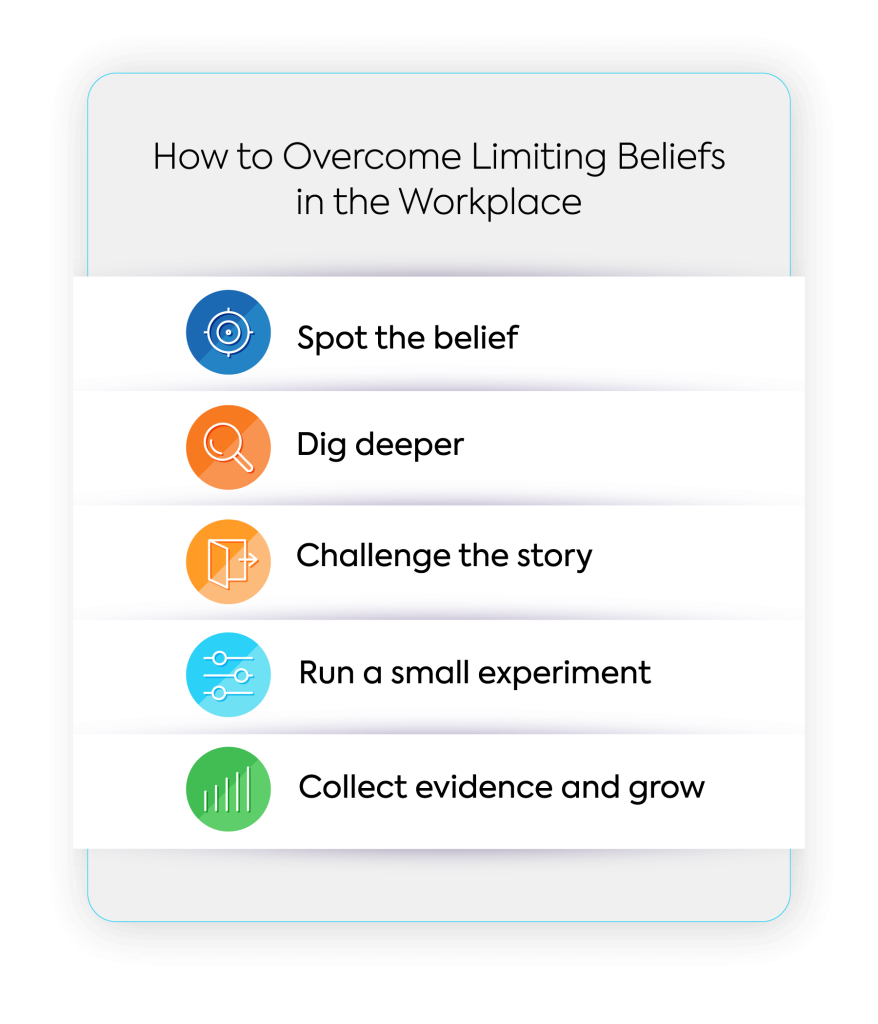
The internal narratives that limit our potential can seem like unshakeable facts Yet, with deliberate effort and the right technique, these deep-rooted beliefs can be improved, opening doors to brand-new degrees of success and contribution in the work environment.
Find the belief
Initially, it is needed to uncover the belief and truly understand its foundations. Go much deeper than simply naming it.
Dig much deeper
Ask looking concerns like:
- When did you initially start believing this?
- What details experiences appear to “show” it true?
- Notably, what has promoting this idea price you in regards to chances or personal development?
Our chef, as an example, could determine the idea, “I’m not effective in high-pressure management roles.”
Obstacle the story
Then, by exploring your origins, they may remember a single overwhelming solution early in their occupation. Recognizing the chances missed out on by staying clear of such duties makes clear truth influence of the idea.
Run a little experiment
With this understanding, the following step is to consciously make a brand-new, empowering narrative and afterwards proactively live your means right into it via small, calculated activities– almost like performing personal experiments.
This might suggest crafting our chef’s counter-belief: “I am constructing my capacity to lead effectively under stress by concentrating on clear communication and team delegation.”
Their initial examination might be leading the planning for just one component of a huge wedding catering event. They would certainly concentrate on entrusting tasks meticulously and allowing the team upgrade them daily.
Collect evidence and expand
Despite exactly how little, each effective experiment builds engaging brand-new evidence, progressively dismantling the old restricting framework and creating long lasting change.

Beginning developing a continuous development way of thinking
Finding and changing limiting ideas is not a last destination yet a consistent method of self-awareness and deliberate development
Fostering atmospheres where this technique is encouraged is a extremely vital part of training for learning and development specialists, human resources supervisors, and local business owner It is about developing rooms where individuals, like our cook striving for brand-new elevations, feel empowered to challenge their own regarded limits.
As Adam Grant sensibly puts it, “a characteristic of an open mind is not letting your ideas become your identification. It’s wanting to rethink your assumptions.”
Embracing this spirit of reconsidering allows both individuals and companies truly gain the advantages of worker training
This aids them be resistant, innovative, and eventually, a more vibrant and capable labor force.
The course onward is just one of continuous understanding and courageous evolution.