by Terry Heick
Humbleness is a fascinating starting point for learning.
In a period of media that is electronic, social, sliced up, and endlessly recirculated, the challenge is no more accessibility however the quality of gain access to– and the response to after that evaluate unpredictability and “fact.”
Discernment.
On ‘Knowing’
There is an appealing and distorted sense of “recognizing” that can lead to a loss of respect and also privilege to “recognize things.” If nothing else, modern-day innovation access (in much of the globe) has changed subtlety with spectacle, and process with accessibility.
A mind that is properly watchful is also appropriately humble. In An Indigenous Hillside , Wendell Berry points to humility and limits. Standing in the face of all that is unidentified can either be overwhelming– or illuminating. Exactly how would it alter the learning process to start with a tone of humility?
Humility is the core of vital reasoning. It states, ‘I don’t understand sufficient to have an educated point of view’ or ‘Let’s find out to decrease unpredictability.’
To be self-aware in your own knowledge, and the limitations of that knowledge? To clarify what can be known, and what can not? To be able to match your understanding with a genuine requirement to recognize– work that normally strengthens essential thinking and sustained questions
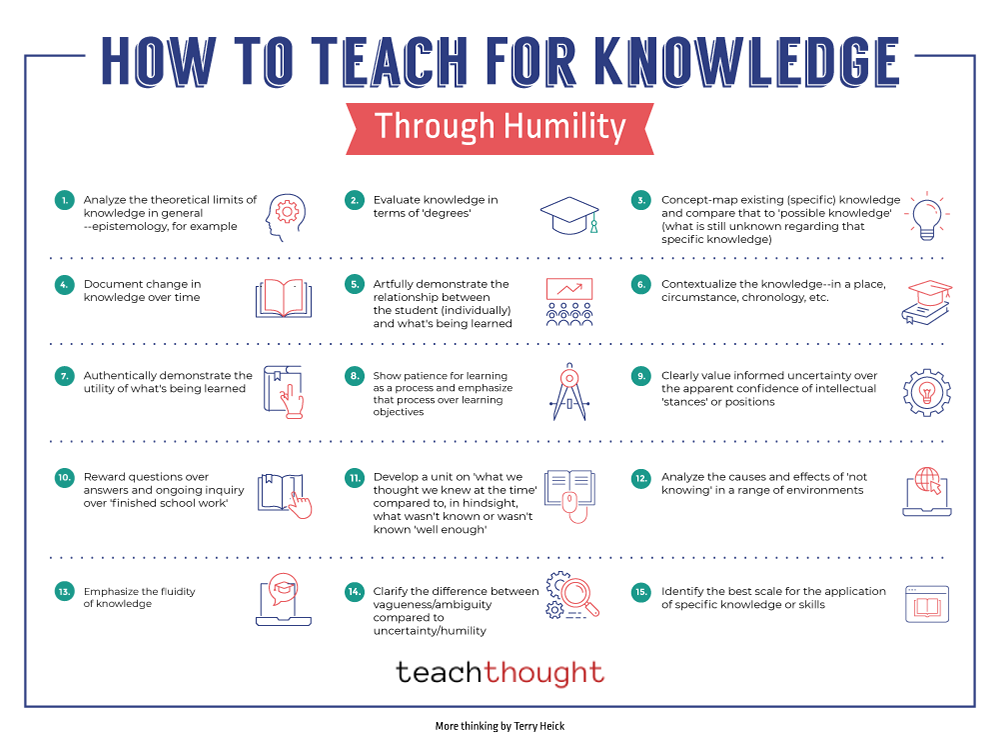
What This Appears like In a Classroom
- Analyze the limits of understanding in plain terms (a simple intro to epistemology).
- Assess expertise in degrees (e.g., certain, possible, feasible, not likely).
- Concept-map what is presently recognized regarding a specific subject and compare it to unanswered concerns.
- Record just how expertise adjustments over time (personal learning logs and historical pictures).
- Show how each student’s perspective shapes their partnership to what’s being learned.
- Contextualize understanding– area, condition, chronology, stakeholders.
- Show genuine utility: where and just how this expertise is made use of outdoors college.
- Program persistence for discovering as a process and highlight that procedure along with purposes.
- Plainly value informed uncertainty over the self-confidence of quick conclusions.
- Compensate ongoing questions and follow-up investigations greater than “ended up” answers.
- Produce a device on “what we believed we understood then” versus what hindsight shows we missed.
- Analyze domino effects of “not recognizing” in science, background, civic life, or day-to-day choices.
- Highlight the fluid, progressing nature of expertise.
- Set apart vagueness/ambiguity (absence of quality) from uncertainty/humility (understanding of limits).
- Identify the most effective range for using details knowledge or abilities (person, regional, systemic).
Research study Note
Research study reveals that individuals who practice intellectual humbleness– wanting to confess what they do not understand– are more open up to learning and much less most likely to hold on to incorrect certainty.
Source: Leary, M. R., Diebels, K. J., Davisson, E. K., et al. (2017 Cognitive and interpersonal attributes of intellectual humbleness Personality and Social Psychology Notice, 43 (6, 793– 813
Literary Example
Berry, W. (1969 “An Indigenous Hill,” in The Long-Legged House New York City: Harcourt.
This concept may appear abstract and level of location in increasingly “research-based” and “data-driven” systems of learning. Yet that belongs to its worth: it helps trainees see knowledge not as dealt with, but as a living procedure they can join with treatment, evidence, and humility.
Mentor For Knowledge, Understanding Through Humbleness