Right, artificial intelligence (AI).
For some time, it seemed like something that would certainly be restricted to web server spaces and coding bootcamps. You recognize, the domain of techies, while the remainder of the organization moved on with, well, whatever else.
However as we sit right here in 2025, that idea is about as present as dial-up web.
Think about the findings from PwC’s 2024 Worldwide CEO Study , where 69 % of global Chief executive officers anticipate AI will certainly call for the majority of their workforce to create new abilities.
This is a clear signal that, apart from the currently widening skills gap , fluency in AI skills is something everybody will certainly be concentrating on for the direct future.
We aren’t speaking about everyone needing to develop intricate formulas, mind you. We’re talking about functional, everyday application– expert system skills that truly reshape just how individuals contribute and collaborate.
Allow’s explore what that really appears like, since honestly, overlooking this merely isn’t a choice.
Why do workers require artificial intelligence (AI) abilities?
Placing it plainly, the factor is efficiency and relevancy.
The days when machine learning was restricted to specialized labs are lengthy gone. It’s now a device, similar to the email or spread sheet software program that came to be crucial years earlier, yet with a far greater capacity to raise result.
Other than this, there’s a real danger of being left New information reveals that by 2025, concerning 78 % of business all over the world will have made use of AI in a minimum of one service feature.
Extra tellingly, 71 % are particularly making use of generative AI designs. Basically, new AI devices aren’t simply being used to assess information and make predictions. They’re additionally being used to create material.
This isn’t a pattern confined to tech giants– it’s permeating sectors from client service (where 56 % usage AI to accounting (30 % fostering).
For the ordinary staff member, the functional ramifications are substantial.
Jobs that as soon as took hours– preparing regular emails, summing up prolonged files, evaluating standard data sets, also creating first advertising copy– can currently be accomplished in minutes with AI support.
PwC evaluation suggests markets most revealed to AI are seeing virtually five times higher labor efficiency growth. On the other hand, roles least revealed are experiencing slower working with growth.
While anxieties of mass job displacement are often overblown (the Globe Economic Forum forecasted a net gain of 58 million tasks worldwide by 2025 because of AI and automation, although with considerable churn), the nature of work is altering.
Employees who recognize exactly how to make use of AI well aren’t just doing their work faster. They’re obtaining info, automating jobs, and utilizing their minds for more crucial, innovative, and calculated work.
AI: Important abilities workers ought to grasp in 2025

Right, since we have actually established why AI fluency is changing from a tech specialism to a general work environment need, allow’s turn our interest to the functional matter: what crucial skills, especially, need to employees outside dedicated tech duties be seeking to grow as we stride with 2025
Fortunately, the needed AI abilities have a tendency to come under unique yet overlapping classifications.
AI proficiency: Recognizing the basics of machine learning
At the foundation exists a general understanding of what AI really is and, probably more most importantly, what it is not. Many employees won’t require to acquaint themselves with the ins and outs of huge language versions, natural language handling, or brand-new programming languages. But a standard summary is essential
An employee comfy with AI proficiency recognizes that while a generative design can compose an email in seconds, it could happily invent truths or perpetuate prejudices otherwise guided and fact-checked.
This category includes:
- Basic AI principles: Knowing the difference between, state, generative AI and analytical AI, and recognizing that these devices run based on data and patterns, not authentic human comprehension or consciousness.
- Ethical and accountable use recognition: Recognizing the potential pitfalls– prejudice in data leading to unjust outcomes, personal privacy problems when inputting sensitive details, or the risk of plagiarism and misinformation.
- Comprehending AI limitations: Understanding that AI lacks context, empathy, and authentic creativity. It is a tool for boosting, not a replacement for human judgment, critical thinking, or nuanced interaction.
- AI protection: Acknowledging that not all systems are safe for sensitive information and that apparently harmless motivates can expose confidential information. This includes understanding which devices are company-approved, exactly how data is stored and made use of, and what methods exist to prevent breaches or misuse.
Practical application skills: Working with the devices and shows languages
Once a fundamental understanding remains in place, the next layer is about hands-on capability– the capability to actually make use of the AI devices properly.
This is probably the most immediately impactful location for the majority of non-tech professionals.
Trick sensible AI skills consist of:
Trigger design
This is arguably the most vital sensible skill right now. It’s the art and scientific research of crafting clear, specific directions (triggers) to obtain the desired outcome from generative AI tools. For an L&D specialist, this may suggest writing a question that generates a clear outline for a new conformity training component. It needs to consist of the people that need to find out, the goals for understanding, and the tone of voice. For an advertising expert or small business owner, maybe motivating AI to create five different advertising taglines for a new product, each targeted at a distinct customer sector.
AI device efficiency
Beyond just motivate engineering, this entails knowledge with specific AI-powered applications appropriate to one’s role or market. This can mean using AI functions installed in familiar staff member training software or using committed AI technologies for details jobs.
Basic data interaction (AI-assisted)
While not requiring computer science understanding, employees do require to have the ability to communicate with AI tools that procedure or reveal information an increasing number of. As an example, a salesman may use an AI device to sum up important trends from client communications. A HR manager can consider generative AI devices to produce insights and activity factors using information collected from staff member pulse surveys.
Meet TalentLibrary ™
A growing collection of prefabricated courses that cover the soft abilities
your teams require for success at the workplace


Augmented human abilities: Prospering together with AI
Remarkably, as AI manages extra regular and also complex analytical jobs, uniquely human abilities do not diminish in value. Rather, they are typically increased and end up being even more important differentiators.
Augmented human abilities for 2025 include:
Important reasoning, analytic, and confirmation
Because AI can create convincing but flawed or prejudiced output, the human capacity to seriously examine info is extremely important. This involves doubting AI results and AI projects, cross-referencing facts, identifying potential predispositions, and applying sound judgment and domain experience.
Creative thinking and innovation (AI-assisted)
AI systems can be an amazing co-pilot for creative tasks. Workers competent below make use of AI as a brainstorming companion, a tool to create preliminary concepts, or a way to quickly produce variations.
Adaptability and continuous knowing
The AI landscape is evolving at breakneck speed. The certain tools and ideal methods of today will likely be different in 2025, let alone 2030 Staff members who flourish will be those with the understanding agility to constantly update their technical abilities, try out new devices, and adapt their workflows.
Ethical judgment and prejudice understanding (application)
Beyond just knowing ethics exist, this is about applying moral judgment in real-time when leveraging AI. It includes making conscious choices about when and how to utilize AI, bearing in mind information personal privacy, staying clear of prejudiced end results, and making use of AI transparently.
Exactly how to recognize AI skills voids
Pinpointing where your organization’s AI ability levels really sit calls for a little bit greater than a suspicion. It indicates looking very closely at exactly how work is currently being done and where AI might realistically add worth or is currently beginning to appear. A abilities gap analysis might be performed through:
- Formal abilities analyses tailored to certain duties– possibly testing prompt-writing ability for material designers or crucial evaluation for experts– are valuable.
- Observing operations can disclose where staff members are battling with brand-new AI attributes in existing devices or missing possibilities to use them.
- Worker self-assessments , when structured properly around the types of AI proficiency and operational application abilities required, likewise give a useful viewpoint.
The objective is to make use of these to get a clear picture of existing capacity versus future demand, concentrating on useful application and liable AI usage, not simply academic knowledge.
How to start establishing AI skills in your organization
As soon as the gaps are recognized, developing capability comes to be the concern.
Begin by providing easy, functional training concentrating on the primary AI skills like quick engineering and responsible device usage. You could do this through in-person workshops, job trailing, or by discovering online resources or AI programs that are arranged by ability.
Additionally, use chances for workers to method utilizing AI in a risk-free environment, perhaps by means of sandboxed devices or pilot projects. Throughout this, urge trial and error and peer-to-peer discovering.
You can also begin incorporating AI tools into day-to-day workflows with clear advice on ideal techniques and enhanced training.
It is a recurring financial investment, equipping your labor force not just for the devices these days, however, for the advancing work environment of tomorrow.
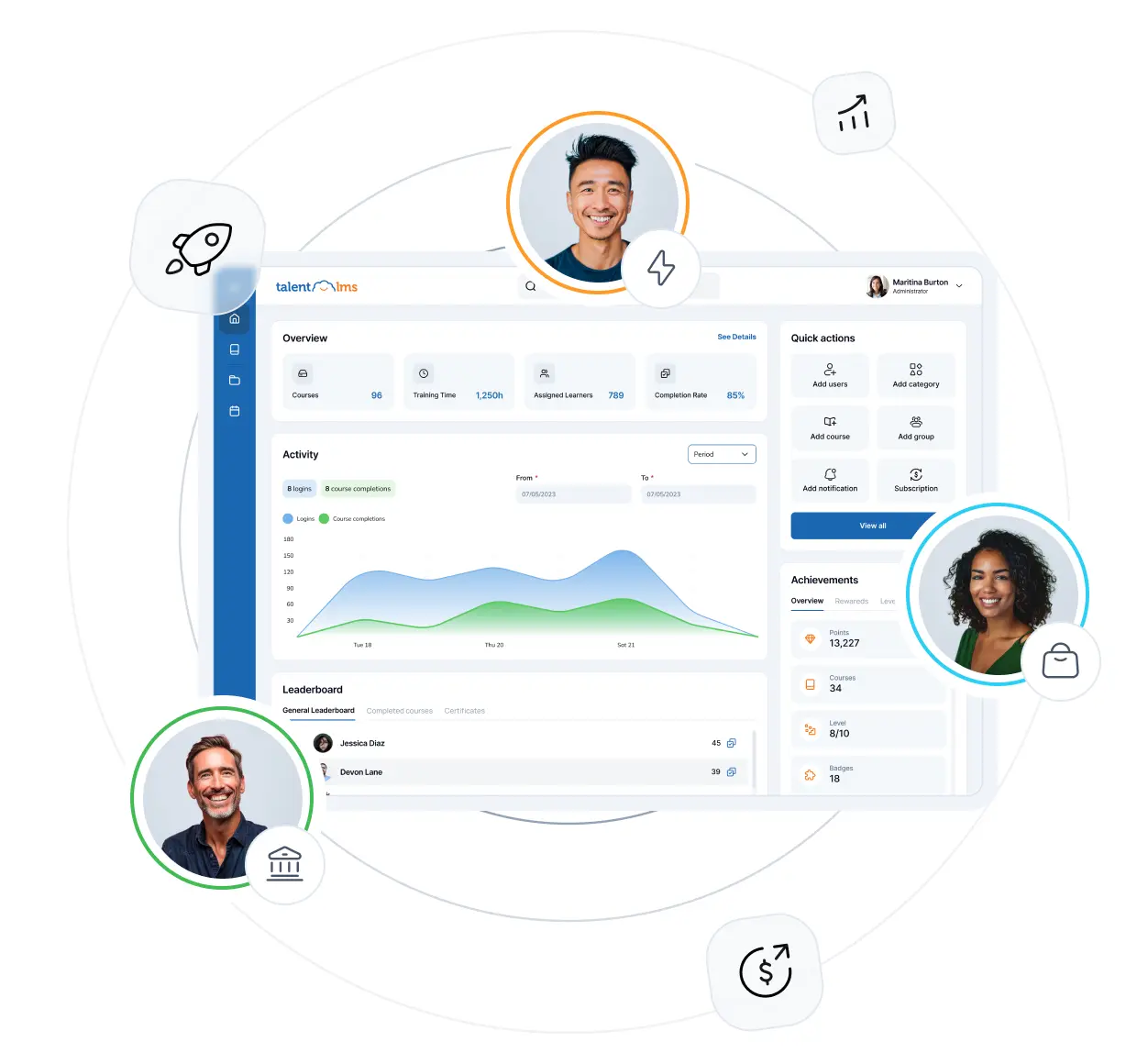
Placing a strategy right into activity means having the best sources at your disposal. For structuring and supplying AI training throughout your labor force, Understanding Management Systems (LMSs) are your absolute staple.
Platforms like TalentLMS can assist workers making use of AI tools by providing a main hub of prefabricated, on-line programs on AI principles, practical tool use, and liable methods. In addition to programs on the leading soft abilities staff members will need to thrive in an AI-led workplace.
An LMS likewise helps you manage different learning paths for various functions, track that’s completed what, and guarantee consistency in distribution. To put your commitment to AI right into technique, choose an LMS with AI capacities integrated in. Leading AI LMS platforms, as an example, usage artificial intelligence to enrich eLearning with attributes that automate a selection of jobs.
Lastly, and perhaps most virtually, offering employees with direct accessibility to the AI devices they’ll in fact use daily, also if it’s a restricted or directed variation at first, is just how they can obtain the real hands-on method. It links the gap in between learning more about AI and finding out by doing with AI.
Get ahead of AI skills discovering
The writing’s on the wall, or perhaps a lot more accurately, embedded within the extremely devices showing up on employee desktops. AI isn’t simply a technology team’s problem any longer– it’s an essential shift affecting the practical fact of every function. As we move through 2025, the message for learning and HR leaders is clear: discovering AI, finding out how to make use of AI tools, and enhancing human abilities with AI are essential.
Equipping staff members with these abilities unlocks potential, drives performance, and protects your organization’s important human edge in the AI-driven future. The need isn’t future-tense– it’s below, and needs concentrated action currently.