Educate Students To Assume Irrationally
by Terry Heick
Official understanding is a humbling point.
As planners, designers, administrators, and basic caretakers of public and exclusive education and learning systems, we are charged with the insurmountable: get rid of a child’s all-natural propensity to play, rebel, and self-direct in hopes of supplying them with a ‘great education and learning.’ Checking out, creating, math, and so on.
And this isn’t incorrect. This is great by virtually any kind of step. Our intent is honorable, our effort remarkable, and absolutely the knowing of numerous children, particularly those from disadvantaged scenarios, is far better than anything they could have had otherwise.
But there’s additionally an unfavorable, darker side to official discovering processes– particularly when you crowd 800 in a college and 32 in a classroom and ‘hold teachers liable.’
This is a side that can be a lot more concerned with that said liability than anything else– which implies pupils liable to educators, instructors liable to principals, principals accountable to superintendents, superintendents accountable to state government agencies, and everybody answerable to many measures of ‘inspiration’ and/or vindictive action.
See also Pupil Involvement Methods
The net result can be an understanding environment where spontaneity, interest, and learner self-direction are secondary to simply the best ‘research-based’ proficiency approach to ‘relocate kids to effectiveness’– and a vital loss of ‘childlishness’ of understanding.
It’s within this context that I watched the following video clip by Adora Svitak, who eloquently (please tell me this youngster was coached, or else I am mosting likely to desire she was also much more ‘juvenile’ herself) discusses the function of ‘immaturity’ in great success. Regarding ‘juvenile’ habits and ‘immaturity,’ she clarifies:
“However, that’s to say that specific sorts of illogical thinking aren’t specifically what the world requires? Perhaps you have actually had grand strategies before however quit yourself, thinking, “That’s impossible,” or, “That costs excessive,” or, ‘That will not benefit me.’
“For far better or worse, we kids aren’t hampered as much when it pertains to considering reasons not to do things. Youngsters can be packed with inspiring ambitions and confident reasoning. Like my dream that no person went hungry or that every little thing were a free type of utopia. How many of you still dream like that and rely on the possibilities? Occasionally a knowledge of history and the past failings of optimistic suitables can be a concern due to the fact that you recognize that if everything were complimentary, then the food supplies would certainly come to be diminished and scarce and cause turmoil. On the various other hand, we youngsters still fantasize concerning perfection.
“And that’s a good thing since in order to make anything a truth, you have to dream concerning it first.”
It’s simple to take that argument a step additionally and question what education and learning would certainly resemble if it were able to truly lose itself in the learning, and be fully engaged in content and community. Criteria? Penalty. Evaluation? Fine– however standardize the assessment without standardizing the discovering.
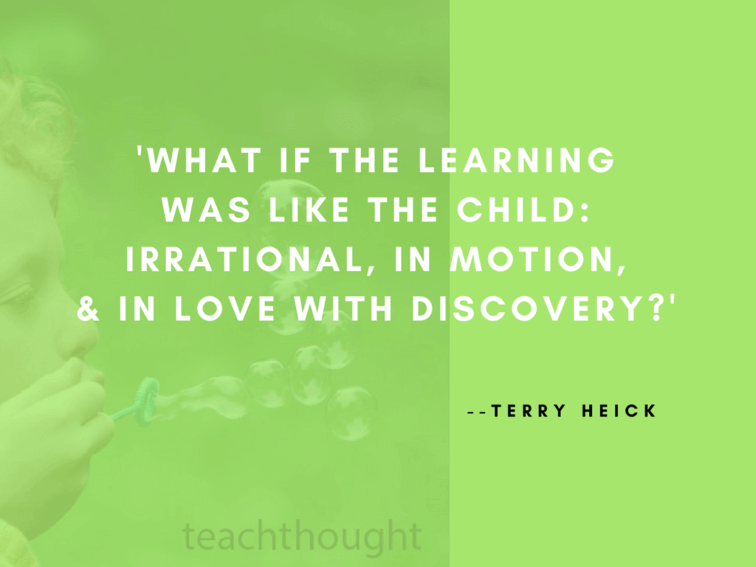
What happens if the knowing was like the kid: irrational, in motion, and crazy with discovery?
You can watch the video clip right here.